Last updated: September 13, 2026
Quick Answer
The Football Intelligence Score (FIS) is a proprietary confidence-rating concept associated with PremierBettingTips.com that summarises model outputs, such as win/draw/loss probabilities, expected goals, and value-edge indicators, into a single readability-friendly figure. As of September 2026, PremierBettingTips.com has not published a formal technical definition, formula, or validation record for this metric in any publicly accessible documentation [4]. The most accurate way to interpret it is as an internal summary rating that reflects how strongly the site’s data-driven football predictions favour a particular outcome.
Key Takeaways
- The Football Intelligence Score is not a standardised, peer-reviewed metric; it appears to be an internal confidence or strength-of-edge rating used within PremierBettingTips.com’s football betting analysis framework [4].
- No public formula, scale definition, or independent validation study exists for the score as of September 2026, so users should treat it as directional guidance rather than a certified measure [4].
- Similar platforms use Poisson (Dixon-Coles) models, expected goals (xG), Kelly Criterion staking, and value-bet detection to produce probabilistic outputs, which are the most likely building blocks behind any such score [5][7].
- Premier Betting Tips covers Premier League betting tips, English Championship predictions, League One betting tips, League Two betting tips, and Scottish Premiership predictions, applying statistical football analysis across all tiers.
- Value betting tips and Asian handicap betting tips are among the most profitable long-term strategies when backed by genuine data, but no single score guarantees consistent returns.
- AI football predictions outperform gut-feel picks on large sample sizes, but accuracy varies by league depth and data availability.
- Responsible football betting means treating any prediction tool, including the FIS, as one input in a broader staking strategy, never as a guaranteed outcome.
What Is the Football Intelligence Score and How Does It Work
The Football Intelligence Score is PremierBettingTips.com’s way of condensing multiple statistical signals into a single confidence indicator for a given match prediction. Rather than presenting raw probability tables, the score gives users a fast read on how strong the data-driven case is for a particular football betting tip.
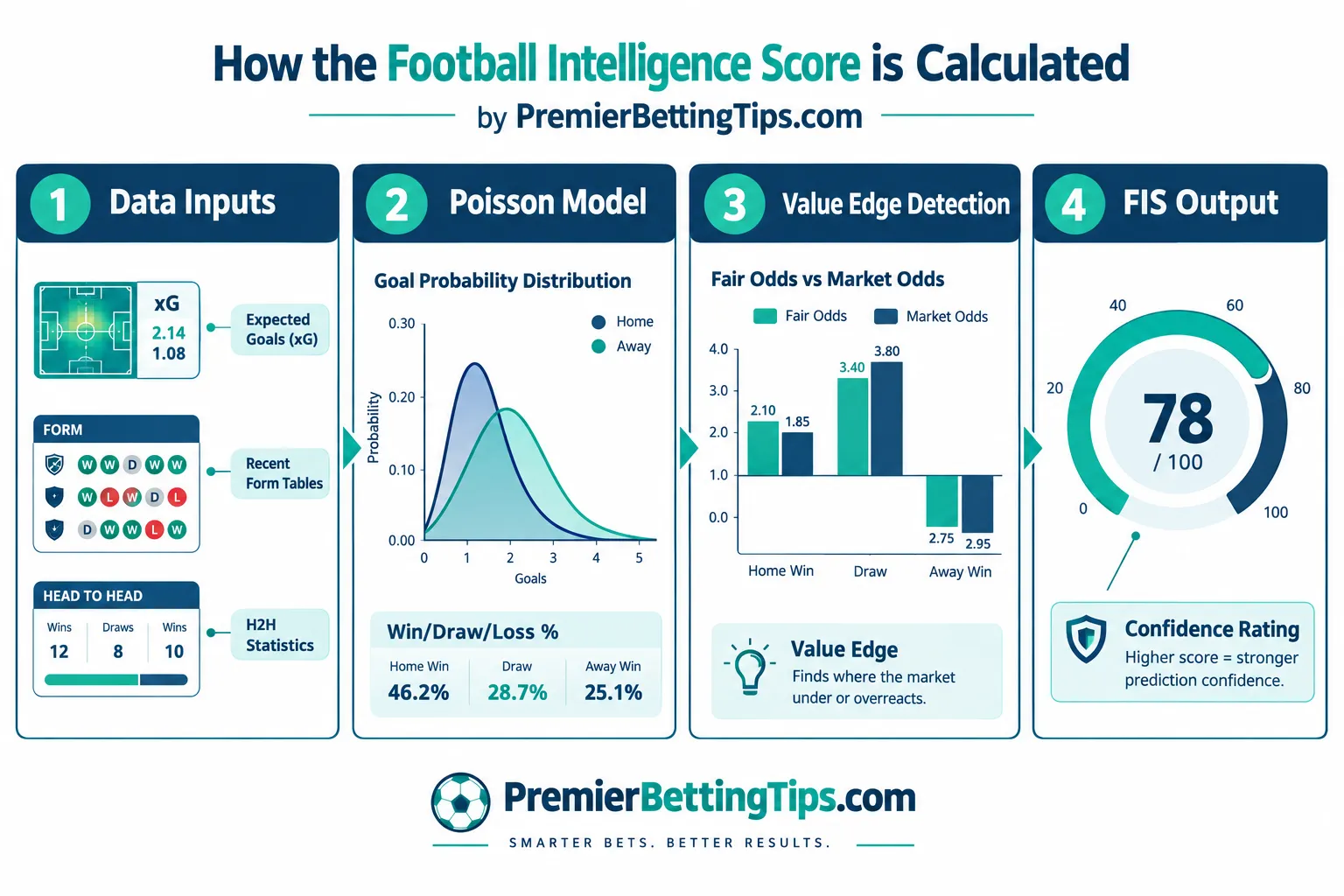
Because no public technical documentation exists for the FIS as of September 2026 [4], the working model is inferred from how comparable football intelligence platforms operate. Sites like FootballInteligence.com use Poisson distribution models, xG values, and fair-odds calculations to generate probabilistic outputs [5][7]. The FIS almost certainly draws on a similar set of inputs and converts them into a scaled rating, likely ranging from low confidence to high confidence, to support today’s football predictions and best football bets today.
What the score likely reflects:
- Win, draw, and loss probabilities derived from a statistical model
- Expected goals (xG) for each team based on recent form and opponent strength
- The gap between model-derived fair odds and current market odds (the value edge)
- Situational match analysis factors such as fixture congestion, travel, and motivation
Decision rule: Use the FIS as a filter, not a guarantee. A high score means the model sees a strong edge; a low score means the data is inconclusive. Always combine it with your own situational match analysis before placing a bet.
How Is the Football Intelligence Score Calculated
No publicly available formula exists for the FIS as published by PremierBettingTips.com [4]. Based on how leading football analytics platforms structure similar outputs, the calculation almost certainly involves three stages.
Stage 1: Probability modelling A Poisson or Dixon-Coles model takes each team’s average goals scored and conceded (adjusted for home/away splits and opponent quality) and outputs win, draw, and loss probabilities [5][7]. This is the statistical backbone of any credible AI football prediction.
Stage 2: Value detection The model compares its fair odds against bookmaker market odds. When the market price is longer than the fair price, a positive value edge exists. This is the core principle behind value betting tips and football value bets [7].
Stage 3: Score aggregation The individual probability and value signals are weighted and collapsed into a single number or rating band. The exact weighting is proprietary and undisclosed [4].
Important note:Because the FIS formula is not publicly documented, users cannot independently verify or replicate the score. Treat it as a useful directional signal, not a mathematically auditable metric.
What Data Does PremierBettingTips.com Use for AI Predictions
PremierBettingTips.com positions itself as a data-driven football predictions platform covering statistical football analysis across UK leagues [4]. The data inputs that underpin its football betting analysis are consistent with industry-standard approaches used by comparable platforms [5][6][7].
Typical data inputs for this class of platform:
| Data Category | Examples |
|---|---|
| Team form | Last 5-10 results, goals scored/conceded |
| Head-to-head records | Historical match outcomes, goal averages |
| Expected goals (xG) | Shot quality, on-target rates |
| Market odds | Opening and closing bookmaker lines |
| Situational factors | Rest days, travel, cup fixture congestion |
| League-specific context | Premier League, Championship, League One, League Two, Scottish Premiership |
The platform applies this data across a wide range of markets, including over 2.5 goals predictions, both teams to score tips, draw no bet predictions, Asian handicap betting tips, and football accumulator tips [4].
How Accurate Are Premier Betting Tips Predictions
No independently audited accuracy record for PremierBettingTips.com’s predictions has been published as of September 2026 [4]. This is a common gap across the football betting tips industry, and users should be cautious of any platform that claims a specific win rate without a transparent, time-stamped record.
What credible accuracy looks like:
- A published log of all tips with dates, odds, and outcomes
- A sample size of at least 200-300 tips before drawing conclusions
- Separate accuracy figures by market type (1X2, BTTS, Asian handicap, over/under)
Platforms that track AI football predictions with documented accuracy tend to show that no model is right more than 55-60% of the time on 1X2 markets over large samples, because bookmaker margins are priced to absorb model edges. Value betting tips, by contrast, are judged by long-run return on investment rather than raw win rate.
Common mistake: Judging a football prediction service by its win percentage alone. A service hitting 45% winners at average odds of 2.20 outperforms one hitting 60% winners at average odds of 1.40.
What Is the Difference Between Asian Handicap and Traditional Betting
Asian handicap betting tips eliminate the draw outcome by giving one team a virtual head start or deficit, expressed in goals. This reduces a three-way market to a two-way market, which is particularly useful when one team is a heavy favourite.
Traditional 1X2 vs Asian Handicap:
- 1X2: Back Team A to win, draw, or Team B to win. Three outcomes, bookmaker margin spread across all three.
- Asian Handicap -1.0: Team A must win by two or more goals. If they win by exactly one, the bet is void and stakes are returned (draw no bet equivalent). Two effective outcomes.
- Asian Handicap +0.5: Team B wins or draws. One effective outcome for the bettor.
Asian handicap accumulator bets combine multiple handicap selections into one slip, multiplying the odds while retaining the draw-protection benefit on each leg. This makes them popular in football accumulator tips strategies where bettors want to back strong favourites without accepting very short odds.
Choose Asian handicap if: The match has a clear favourite but the 1X2 win odds are too short to represent value, or you want draw protection on a selection.
Is Value Betting Actually Profitable Long Term
Value betting is profitable long term when the bettor consistently identifies odds that are longer than the true probability of an outcome. This is the mathematical foundation of professional football betting analysis.
The Kelly Criterion, a staking formula used by quantitative bettors, sizes each bet in proportion to the edge detected by the model [7]. A positive expected value (EV) bet placed at the correct stake will, over hundreds of bets, produce a positive return on investment regardless of short-term variance.
Practical constraints on long-term profitability:
- Bookmakers limit or close accounts of consistently profitable bettors
- Model edges erode as markets become more efficient
- Discipline in staking is as important as the quality of the football value bets themselves
Edge case: Value betting works best in lower-profile markets (League Two betting tips, Scottish Premiership predictions) where bookmaker pricing is less sharp than in the Premier League.
Are AI Football Predictions Better Than Expert Picks
AI football predictions outperform unaided expert opinion on large sample sizes because they process more variables consistently and without emotional bias. However, the quality of an AI model depends entirely on the quality and depth of its training data.

Platforms such as KiqIQ use live xG and Poisson models to generate real-time probabilities [6], while FootyPulse frames its outputs as a “football intelligence” platform [9]. Across these services, the consensus is that AI models add genuine value in markets with abundant data (Premier League, Championship) and less value in data-sparse environments.
Where expert picks still add value:
- Injury news that has not yet been priced into models
- Tactical changes announced in pre-match press conferences
- Motivational context (relegation battles, title run-ins) that situational match analysis may weight differently than a pure statistical model
Best practice: Combine data-driven football predictions with a brief manual check of team news before finalising weekend football predictions or best football bets today.
How to Use the Football Intelligence Score to Place Bets
Using the FIS effectively means treating it as a shortlist tool rather than a final decision. A high score narrows the field of candidates; the bettor then applies additional checks before committing a stake.
Step-by-step process:
- Review the day’s football intelligence scores on PremierBettingTips.com [4].
- Filter for scores above your chosen threshold (e.g., top quartile of confidence ratings).
- Check the implied market odds against the model’s fair odds to confirm a value edge exists.
- Review team news, recent form, and any situational match analysis flags (rest, travel, cup fatigue).
- Apply a fixed or Kelly-fraction stake consistent with your bankroll management rules.
- Record the bet in a personal log for long-term performance tracking.
Common mistake: Placing bets on every high-scoring prediction without checking whether the market odds still reflect the edge. Odds move; a high FIS calculated at 9am may no longer represent value by kick-off.
What Are the Most Common Mistakes with Accumulator Bets
Football accumulator tips are popular because small stakes can return large payouts, but the structure of accumulators works against the bettor mathematically unless every selection carries a genuine value edge.
Top mistakes:
- Adding “banker” selections at very short odds (below 1.30) that add minimal value but increase the parlay’s vulnerability
- Mixing markets (1X2 with BTTS with over/under) without understanding how correlations between legs affect the true probability
- Chasing losses by increasing accumulator size after a losing run
- Ignoring the bookmaker’s accumulator bonus terms, which often apply only to pre-match bets
Better approach: Limit football accumulator tips to four to six legs maximum. Use Asian handicap accumulator selections where draw protection reduces the number of ways a leg can lose. Only include legs where the individual selection meets your value-bet criteria.
What Does Responsible Football Betting Actually Mean
Responsible football betting means applying consistent bankroll management, maintaining realistic expectations about long-term returns, and never betting money that cannot be afforded to lose. It is not just a regulatory disclaimer; it is a practical framework that separates sustainable bettors from those who burn out quickly.
Core principles of responsible football betting:
- Set a fixed betting bank separate from personal finances
- Stake no more than 1-5% of the bank on any single selection
- Keep a full record of all bets, wins, and losses
- Take breaks after losing runs to avoid emotionally driven decisions
- Use the self-exclusion and deposit-limit tools offered by licensed operators
- Treat football betting analysis as entertainment with a potential return, not as a primary income source
PremierBettingTips.com explicitly frames its service around “responsible betting intelligence” [4], which signals that the platform expects users to apply these principles alongside its predictions.
FAQ
What is the Football Intelligence Score in simple terms? It is a confidence rating produced by PremierBettingTips.com that summarises how strongly the site’s statistical model backs a particular match outcome. A higher score means the data points more clearly in one direction [4].
Is the Football Intelligence Score publicly documented? No. As of September 2026, PremierBettingTips.com has not published a formula, scale, or validation record for the score [4].
Which leagues does PremierBettingTips.com cover? The platform covers Premier League betting tips, English Championship predictions, League One betting tips, League Two betting tips, and Scottish Premiership predictions, among other competitions [4].
What is the difference between value betting and normal betting? Normal betting picks the most likely outcome. Value betting identifies outcomes where the bookmaker’s odds are longer than the true probability, creating a positive expected return over time [7].
Can I use the Football Intelligence Score for Asian handicap bets? Yes. The score is applicable across markets including Asian handicap betting tips, over 2.5 goals predictions, both teams to score tips, and draw no bet predictions, as long as the underlying model covers those markets.
How often are predictions updated on PremierBettingTips.com? Predictions for today’s football predictions and weekend football predictions are typically updated as team news and odds movements emerge, so checking within 24 hours of kick-off is advisable [4].
Are AI football predictions guaranteed to make money? No prediction system guarantees profit. AI football predictions improve decision quality over large samples but cannot eliminate variance or guarantee returns in any given period [5][7].
What is situational match analysis? Situational match analysis examines non-statistical context, such as fixture congestion, travel demands, and motivational factors, to adjust the raw probability output of a model before a bet is placed.
What does Draw No Bet mean? Draw No Bet is a market where stakes are returned if the match ends in a draw. It is effectively a two-outcome market and is closely related to Asian handicap 0 betting.
How many legs should a football accumulator have? Four to six legs is a widely recommended range. More legs multiply the probability of at least one selection losing, which reduces the long-term expected return of football accumulator tips.
Is the Football Intelligence Score the same as xG? No. Expected goals (xG) is one input into a broader model. The FIS is a summary output that likely incorporates xG alongside other metrics such as form, value edge, and situational factors.
What should I do if a prediction looks strong but the odds have shortened? Recalculate whether the current odds still represent value. If the market has moved to reflect the model’s edge, the bet may no longer be worth placing regardless of the Football Intelligence Score.
Conclusion
The Football Intelligence Score designed by PremierBettingTips.com is best understood as a proprietary confidence rating that distils statistical football analysis, including probability modelling, expected goals, and value-edge detection, into a single actionable signal. Because no public formula or independent audit exists for the score as of September 2026, users should treat it as a useful directional tool rather than a certified metric [4].
Actionable next steps:
- Visit PremierBettingTips.com and review the current FIS ratings alongside the underlying match data for today’s football predictions [4].
- Cross-reference high-scoring selections against live market odds to confirm a value edge still exists before placing a stake.
- Apply responsible football betting principles: fixed bankroll, recorded bets, and realistic return expectations.
- For deeper statistical context, explore how Poisson models and Kelly Criterion staking work on platforms such as FootballInteligence.com [7] to build a stronger foundation for interpreting any AI football prediction output.
- Revisit weekend football predictions within 24 hours of kick-off to account for team news and odds movements.
No score, model, or platform replaces disciplined staking and honest record-keeping. The FIS is a starting point, not a shortcut.
References
[4] premierbettingtips – https://premierbettingtips.com/ [5] Ai Football Calculator – https://footballinteligence.com/ai-football-calculator [6] kiqiq – https://kiqiq.com/ [7] footballinteligence – https://footballinteligence.com/ [9] footypulse.co.uk – https://footypulse.co.uk/