
both teams to score tips should begin with transparent football research rather than an unexplained pick. This guide focuses on assessing whether both sides can find a goal and shows how to assess the evidence, question the assumptions and recognise when a match is too uncertain to call. It is an educational method, not a list of guaranteed selections.
Define the question precisely
BTTS Yes requires each side to score at least once in the specified period.
Before using any statistic, verify its season, competition, home-and-away split and sample size. A percentage calculated from five games is much less stable than one based on a longer, representative set. Even a larger sample can become less relevant after a manager or squad changes. Readers should know exactly what was measured and why it matters to this particular fixture.
Verify the supporting evidence
A 3–0 match loses BTTS Yes despite producing three goals; a 1–1 match wins BTTS Yes with only two.
Consider goals for and against, shot locations, expected goals, expected goals conceded and the strength of recent opponents. Expected goals is a model-based summary of chance quality, not a promise of the next score. Different data providers may produce different values, and a penalty or red card can materially distort a single match’s profile.

Compare football context with the numbers
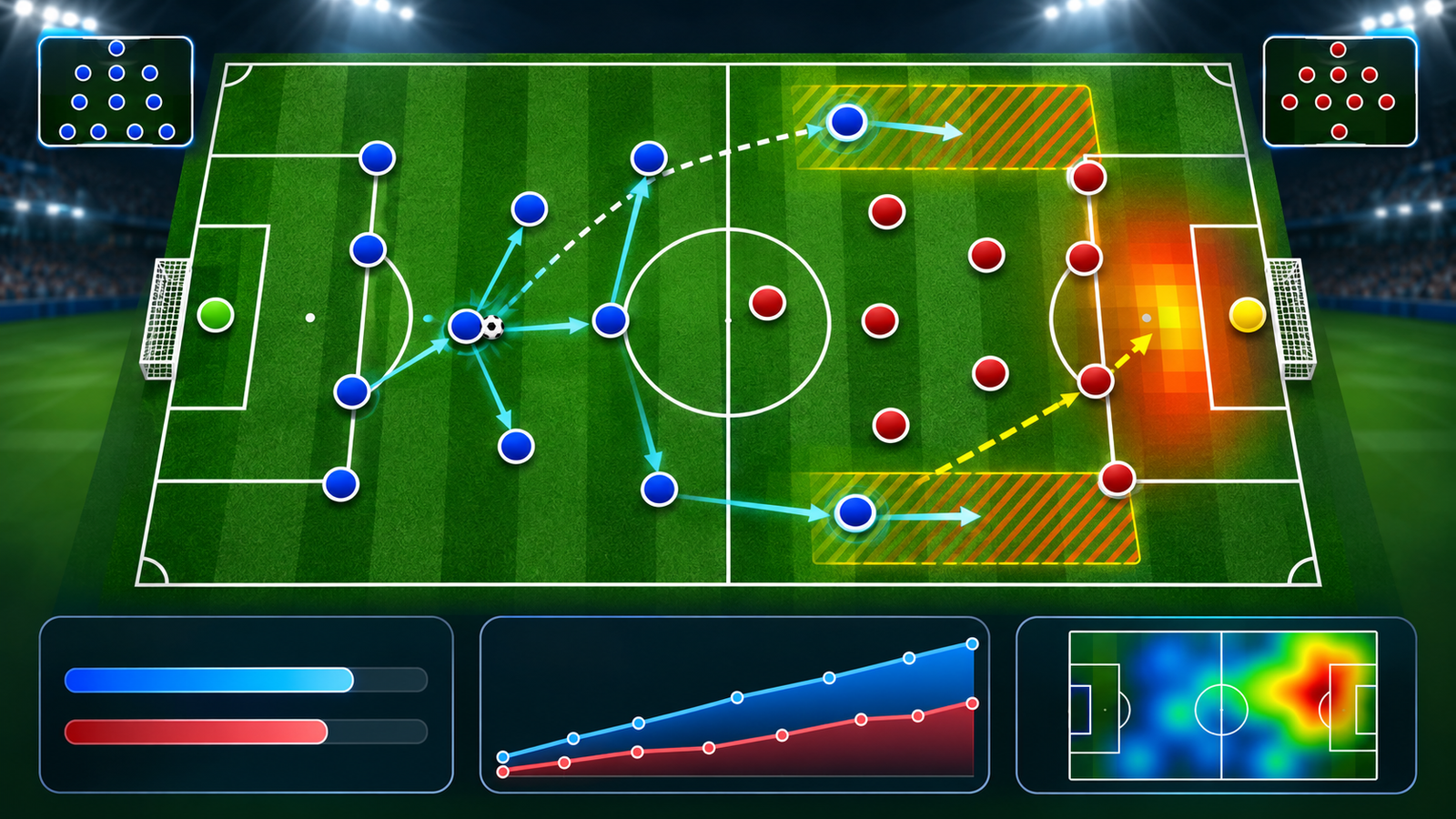
Check whether both attacks create chances and whether both defences allow opponents into dangerous positions.
Style is an important part of the comparison. A high-pressing side may struggle against opponents able to play directly into space. A deep defence can concede possession without conceding dangerous chances. Check line-ups, availability, fixture congestion and whether the teams have a realistic reason to alter their normal approach.
Understand what could change
Venue splits, missing defenders and tactical approaches can change the match-up.
Football markets are specific contracts. A standard 90-minute result includes stoppage time but generally excludes extra time and penalties. Goals markets have different thresholds; BTTS is not equivalent to Over 2.5. A draw-no-bet refund differs from a double-chance win. Always read the exact settlement wording rather than relying on a market nickname.
Avoid misleading shortcuts
Beware of using each team’s scoring percentage as though the events were independent.
A strong-sounding forecast is not necessarily a good price. For an ordinary binary outcome at decimal odds of 2.00, the break-even probability is 50% before fees. That calculation does not prove the event has a 50% chance. A genuine value assessment requires an independent, well-supported estimate and an allowance for modelling error.
Decide whether the conclusion is justified
A high combined goals average does not prove that both teams will contribute.
Write down the original view, the publication time, available odds, unresolved uncertainties and later outcome. Keep the prediction unchanged after kick-off so the record remains auditable. Compare performance over many settled selections, including losing runs. If the evidence is inadequate, saying ‘no selection’ is a meaningful analytical result.
Practical research example
Imagine two unnamed teams preparing for a league match. The hosts have collected more points recently, but several victories came against weaker opposition. The visitors have a modest away record yet regularly create good chances. One of the hosts’ defenders is doubtful and the away team may alter its formation. None of these observations determines the result by itself. Together they identify questions worth checking before reaching a view about assessing whether both sides can find a goal.
Suppose an analyst estimates a hypothetical outcome at 55% and sees decimal odds of 1.70. The implied break-even probability is approximately 58.8%, so that estimate would not justify the price. At odds of 2.00, the arithmetic changes, but only if the 55% estimate is reliable. These numbers are examples, not live recommendations or calibrated match predictions.
How Premier Betting Tips strategies fit
Use Situational Match Analysis to consider team news, tactical fit and schedule pressure. Consult First-Half Goal Index when the opening 45 minutes matter, and Over/Under 1.5 Goals Strategy or Over/Under 2.5 Goals Strategy when analysing goal totals. The Football Intelligence Reports archive offers dated examples of evidence-led match assessments. These resources support different research questions; no score or label should be mistaken for a guaranteed probability.
Questions to ask before acting
- Is the fixture date, venue and competition confirmed?
- Are the statistics current, sourced and relevant to the specific market?
- Have confirmed line-ups or late injuries changed the original analysis?
- Does the price reflect the uncertainty, and is the market settlement understood?
- Would declining to make a selection be the more disciplined conclusion?
Frequently asked questions
Are both teams to score tips guaranteed?
No. Match outcomes remain uncertain, and even evidence-based assessments can be wrong.
Which football statistics should I prioritise?
Use a balanced view of chance quality, opponent strength, venue-specific form, availability and tactics. No single number is decisive.
Can odds replace match analysis?
No. Odds are market prices; they are not independently verified probabilities.
When should I reconsider a prediction?
Reassess after material team news, confirmed line-ups, significant changes to the fixture or meaningful price movement.
Is it reasonable not to bet?
Yes. A transparent no-bet decision is appropriate whenever the evidence or price does not support a conclusion.
Conclusion
Reliable both teams to score tips content should be transparent about methods, timestamps, limitations and uncertainty. Start with the fixture and the market, examine the relevant evidence and record the reasoning before the result is known. Explore the Premier Betting Tips strategy hub for further research tools.
Responsible gambling: 18+. No football prediction or betting strategy guarantees profit. Only risk money you can afford to lose, never chase losses and visit GambleAware if gambling is causing harm.