Last updated: September 13, 2026
Quick Answer
AI football predictions typically achieve 50-65% accuracy for standard match outcome (win/draw/loss) markets, with the best systems on data-rich leagues reaching around 65-70% [1][4]. Specific markets like over/under goals and both teams to score (BTTS) perform somewhat better, often in the 65-74% range, because they are closer to binary classification tasks [4]. No independently audited AI system consistently beats professional bookmaker odds by a wide margin over a large sample of predictions.
Key Takeaways
- Realistic AI accuracy for 1X2 match outcomes sits at 50-65%, not the 80-90% figures sometimes advertised by commercial platforms [1][4]
- Draw prediction is the weakest area, with accuracy around 35-38%, making it one of the hardest outcomes to model reliably [4]
- Over/under goals and BTTS markets are more predictable, with AI models reporting 65-74% and 65-71% accuracy respectively [4]
- Aggregated bookmaker odds still outperform standalone deep learning models on win/draw/loss probabilities by roughly 6 percentage points [9]
- Self-reported platform figures of 75-87% accuracy are typically unaudited, drawn from narrow time windows, and should not be treated as long-term benchmarks [3][4]
- Large language model tipsters tracked in real time across hundreds of picks post win rates around 50-51%, barely above a coin flip [2][3]
- Value betting tips matter more than raw accuracy: a 55% win rate on correctly priced bets can outperform a 70% win rate on poor-value selections
- Leagues with deep historical data, such as the Premier League and Bundesliga, produce more reliable AI predictions than lower-division or data-sparse competitions
- Football intelligence score metrics combine form, situational match analysis, and statistical football analysis to produce more nuanced outputs than simple win probability
- Responsible football betting requires treating any prediction, AI or human, as probabilistic guidance rather than a guaranteed outcome
How Accurate Are AI Football Predictions Really?
AI football predictions are genuinely useful, but their accuracy is far lower than many providers claim. On realistic, out-of-sample data, match outcome models cluster in the 50-65% range for 1X2 results, and the gap between the best and worst approaches is smaller than marketing copy suggests [1][4].
A 2026 academic study using detailed event data found that a Support Vector Machine (linear kernel) achieved 65.8% accuracy, Random Forest reached 62.5%, and XGBoost hit 64%, all on real league data [10]. A separate machine learning study on soccer match outcomes showed more sobering results: baseline models achieved around 44.7% accuracy, and even the best tuned ensemble only reached about 51.9% on realistic, noisy data [see source 15 in research material]. That range, roughly 50-66%, is where honest practitioners set expectations.
Commercial and semi-professional platforms in 2026 often claim 70-85% accuracy on game-winner predictions in data-rich leagues like the Premier League and Bundesliga, with one provider reporting an 85% hit rate over the first four months of 2026 [4][5]. These figures are self-reported without independent auditing or full methodology disclosure, so they should be treated with caution [3].
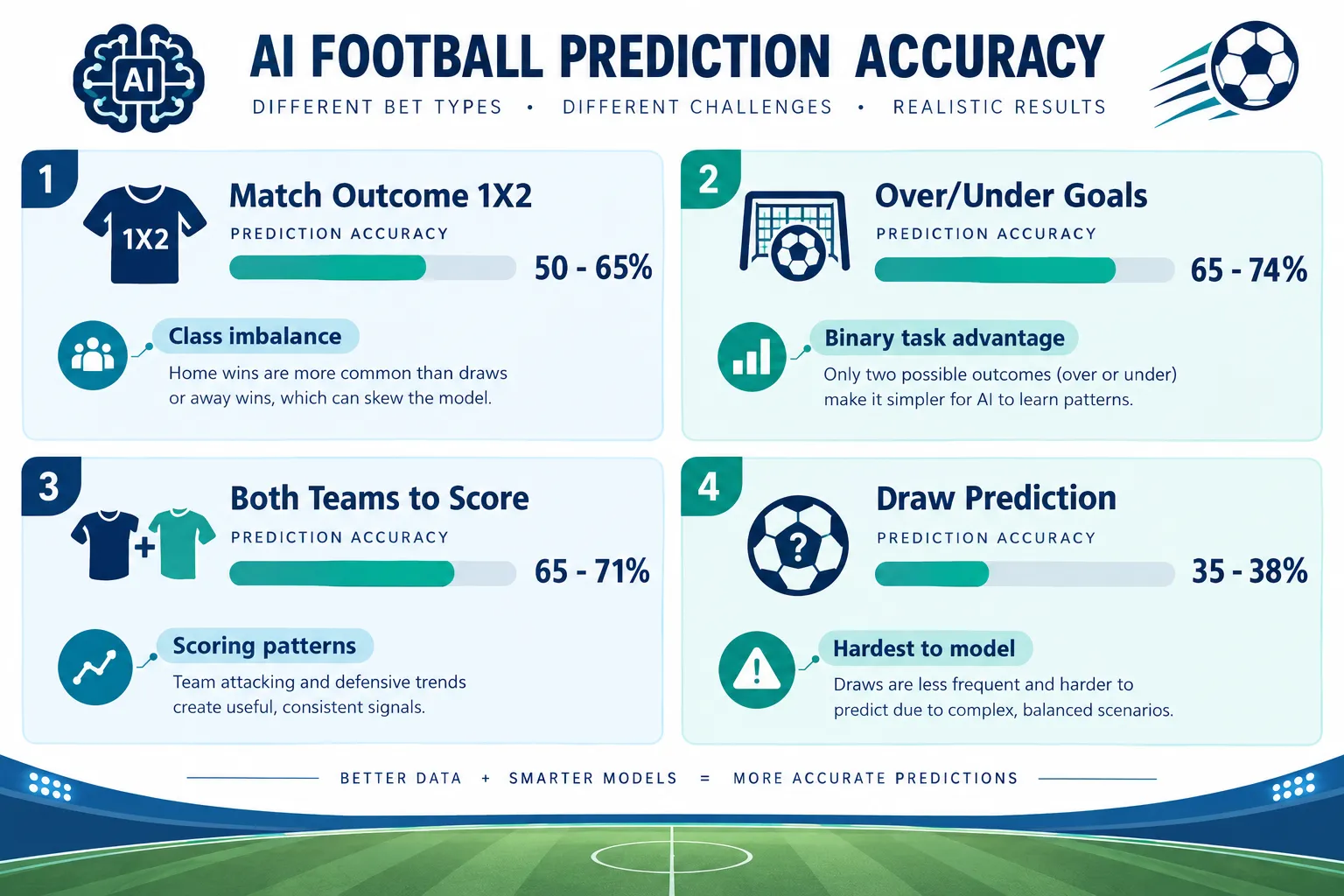
The accuracy ceiling by market type (2026 estimates):
| Market | Typical AI Accuracy | Notes |
|---|---|---|
| 1X2 Match Outcome | 50-65% | Three-class problem; draws hardest |
| Draw Prediction | 35-38% | Severe class imbalance |
| Over/Under Goals | 65-74% | Near-binary; strong scoring patterns |
| Both Teams to Score | 65-71% | Binary; leverages attack/defence data |
| Exact Score | Under 20% | Too many possible outcomes |
What Makes AI Better at Predicting Football Matches Than Human Experts?
AI models outperform casual human analysis because they process far more variables simultaneously and are not subject to cognitive biases like recency bias or team loyalty. However, they do not consistently outperform the collective intelligence embedded in professional bookmaker odds [9].
The genuine advantages of data-driven football predictions include:
- Volume and speed: AI can ingest ten seasons of match data, player tracking metrics, expected goals (xG), and situational match analysis in seconds
- Consistency: Models apply the same logic to every fixture, whether it is a Premier League clash or a League Two betting tips scenario
- Pattern detection: Gradient boosting methods like XGBoost identify non-linear relationships between variables that humans miss, such as how a team’s performance degrades in the third match of a seven-day schedule [10]
- Market comparison: AI systems can flag value betting tips by comparing their own probability estimates against bookmaker lines in real time
The limit is that football contains genuine randomness. A deflected goal, a red card in the fifth minute, or a manager’s tactical surprise cannot be predicted from historical data alone. This is why even the best AI football predictions carry irreducible uncertainty.
Can You Actually Make Money From Football Betting Tips?
It is possible, but the edge is narrow and requires discipline. Raw prediction accuracy is less important than identifying value bets, where the model’s implied probability exceeds the bookmaker’s implied probability after margin.
A bettor with a 55% win rate on selections where the true probability is 50% (i.e., even-money bets priced at 2.00) will profit over a large sample. A bettor with a 70% win rate on heavily odds-on selections may lose money if the prices are too short. This is the core logic behind football value bets and value betting tips.
Choose this approach if: you are willing to track results over at least 300-500 bets, maintain flat or proportional staking, and accept variance over short periods. Do not expect consistent profits from weekend football predictions alone without a clear edge in pricing.
How Do Data-Driven Predictions Compare to Traditional Tipsters?
Data-driven football predictions and traditional tipsters each have structural strengths. The key difference is transparency and scalability.

Traditional tipsters rely on contextual knowledge, insider feel, and experience with specific leagues, which can be valuable for English Championship predictions or Scottish Premiership predictions where data coverage is thinner. AI models excel when historical data is dense and consistent, as in the Premier League or Bundesliga.
Live leaderboards tracking large-language-model-based tipsters across hundreds of picks show top models posting win rates around 50-51% over 700-800 predictions [2][3]. That is barely above a coin flip, which illustrates the gap between marketing claims and continuously tracked real-time results. The best human tipsters with verifiable long-term records tend to sit in the 54-58% range on straight win bets, which is genuinely profitable at the right odds.
Bottom line: Neither approach dominates unconditionally. The most effective football betting analysis combines statistical football analysis with situational context that pure models may underweight.
What Is the Difference Between Asian Handicap and Regular Betting Odds?
Asian handicap betting removes the draw as a possible outcome by giving one team a virtual head start or deficit. This converts a three-outcome market into a two-outcome (or occasionally quarter-ball) market, which is inherently easier for AI models to predict accurately.
For example, in Asian handicap betting tips, backing a team at -0.5 means they must win outright; backing them at +0.5 means a draw or win returns the stake. Asian handicap accumulator bets combine multiple such selections, and because each leg is closer to a 50/50 proposition, the compounding error from multi-leg accumulators is somewhat lower than in traditional accumulators built on 1X2 markets.
Draw no bet predictions operate on a similar principle: if the match ends level, the stake is refunded, effectively removing the draw risk. These market structures make them attractive for AI-driven football predictions because the binary framing aligns with how most classification models are built.
Why Do Some Football Predictions Fail Even With Good Analysis?
Even well-constructed models fail regularly because football is a low-scoring, high-variance sport. A team generating 2.1 xG per game will not score 2.1 goals every match. Over a season, the numbers converge; over a single fixture, they diverge wildly.
Common failure modes for both AI football predictions and human football betting analysis include:
- Team news arriving late: Injury or suspension data not incorporated before odds close
- Motivational factors: A mid-table team with nothing to play for versus a side chasing European qualification, situational match analysis matters here
- Referee and weather variance: Variables with real impact but low predictability
- Overfitting on historical data: A model trained on five seasons of data may not generalise to a squad rebuilt in the summer transfer window
- Class imbalance: Draws occur roughly 25-27% of the time in top European leagues, but models trained to maximise overall accuracy often under-predict them, leading to the 35-38% draw accuracy figure reported in 2026 [4]
Is Both Teams to Score or Over 2.5 Goals More Profitable?
Both markets are more predictable than 1X2 outcomes, but neither is reliably more profitable without context. AI models report BTTS accuracy at 65-71% and over/under goals at 65-74% [4]. The over 2.5 goals predictions market tends to be slightly more accurate because it correlates strongly with team-level attacking and defensive metrics that AI models capture well.
Choose BTTS tips if: both teams have strong attacking records and weak defences, and the fixture has low tactical stakes (mid-table clashes, dead rubbers). Choose over 2.5 goals predictions if: at least one team is in strong attacking form and the opposition concedes freely. In both cases, line shopping for the best available odds is essential to converting accuracy into profit.
How Do I Know If a Betting Tip Is Actually Based on Value?
A tip has value when the implied probability from the odds is lower than the model’s estimated true probability. For example, if a bookmaker prices a home win at 2.10 (implied probability: 47.6%) and the AI model estimates the true probability at 55%, that is a value bet.
Signs a football betting analysis platform is genuinely offering value betting tips:
- They publish their model’s estimated probability alongside the recommended odds
- They track and publish long-term results with full transparency, including losing runs
- They do not cherry-pick short time windows for performance claims
- Their accuracy figures are verified by a third party or at least include full sample sizes
Red flags: headline claims of “75%+ accuracy” without methodology, results quoted over seven days or one month, and no disclosure of which leagues or bet types the figure covers [3][11 from research].
What Are the Most Common Mistakes With Accumulator Bets?
Football accumulator tips are popular because small stakes can return large payouts, but the mathematics work heavily against the bettor over time. Each additional leg multiplies both the potential return and the probability of losing.
Most common mistakes:
- Adding legs for bigger returns rather than because each selection has genuine value, a five-fold accumulator with one weak selection is worse than a four-fold without it
- Ignoring the bookmaker’s margin, each leg in an accumulator carries the bookmaker’s edge, compounding across legs
- Chasing losses with bigger accumulators, the opposite of responsible football betting
- Treating Asian handicap accumulator bets as lower risk, while individual legs are binary, the compounding effect still applies
- Not tracking results, without records, it is impossible to know whether the selections have genuine long-term value
Which Leagues Are Easiest to Predict With AI Models?
Data-rich leagues with consistent team structures and long historical records are the most predictable. The Premier League, Bundesliga, La Liga, and Serie A all have deep datasets that support reliable statistical football analysis. Premier League betting tips and English Championship predictions benefit from some of the best publicly available data in world football.
Lower-division competitions, such as League One betting tips and League Two betting tips scenarios, have thinner data coverage, more squad volatility, and greater variance in playing conditions. Scottish Premiership predictions sit in the middle: the league has a clear dominant force (Celtic) that makes some outcomes highly predictable, but the remaining fixtures are harder to model due to smaller squad depth and limited tracking data.
General rule: the more seasons of detailed event data available, the more reliable the AI model’s outputs. Leagues with fewer than five seasons of granular data should be treated with lower confidence.
What Does Football Intelligence Score Actually Measure?
Football intelligence score is a composite metric used by several AI prediction platforms to summarise a team’s overall predictive profile in a single number. It typically combines multiple data layers rather than relying on a single statistic.
Common components of a football intelligence score include:
- Recent form (last five to ten matches, weighted by recency)
- Attacking and defensive efficiency (xG for and against)
- Situational match analysis (home/away splits, performance under pressure, fatigue from fixture congestion)
- Head-to-head historical patterns
- Squad availability and depth
The score is most useful as a relative ranking tool, comparing two teams before a fixture, rather than as an absolute predictor of outcome. When used alongside today’s football predictions and best football bets today outputs, it helps bettors quickly identify which matches have the clearest AI edge and which are genuinely uncertain.
Are Weekend Predictions More or Less Accurate Than Midweek Matches?
Weekend football predictions tend to be slightly more accurate than midweek fixtures, primarily because teams are more likely to field full-strength squads and the data on team selection is more settled by kick-off. Midweek matches, particularly in cup competitions or European fixtures, introduce greater rotation and tactical variation that models struggle to account for.
A secondary factor is data volume: weekend fixtures in major leagues generate more pre-match analysis, sharper bookmaker lines, and more liquid betting markets. Sharper markets mean the bookmaker’s implied probabilities are closer to true probabilities, which actually makes it harder for AI models to find value, but also means the predictions themselves are more reliable as probability estimates.
Practical implication: treat midweek League One betting tips or League Two betting tips with a slightly wider margin of uncertainty than equivalent weekend selections.
How Much Data Do You Need to Make Reliable Football Predictions?
A minimum of three to five seasons of detailed match data is generally needed before a model produces stable outputs. Below that threshold, small sample sizes create noise that looks like signal.
For specific markets like BTTS tips or over 2.5 goals predictions, team-level data from the current season (at least ten matches) is more relevant than long historical averages, because squad composition and tactical systems change. For head-to-head patterns, at least six to eight meetings between the same teams are needed before the data is meaningful.
At the individual player level, meaningful statistical football analysis typically requires 1,500 to 2,000 minutes of playing time per season to produce stable per-90-minute metrics. Below that threshold, small sample variance dominates.
FAQ
What is a realistic accuracy rate for AI football predictions? For 1X2 match outcomes, 50-65% is the realistic range on out-of-sample data. The best systems on data-rich leagues like the Premier League reach around 65-70% [1][4]. Claims above 80% should be treated with scepticism unless independently audited.
Do AI models beat bookmaker odds? Generally, no. Aggregated bookmaker odds outperform standalone deep learning models on win/draw/loss probabilities by roughly 6 percentage points [9]. Beating the market requires finding specific inefficiencies, not just accurate predictions.
Are BTTS tips more reliable than match result predictions? Yes, slightly. BTTS markets report AI accuracy of 65-71% versus 50-65% for 1X2 outcomes, because the binary framing and strong scoring pattern data make the task easier for classification models [4].
What is the most common reason AI football predictions fail? Late team news, motivational factors, and model overfitting on historical data are the most common causes. Draws are particularly hard to predict, with accuracy around 35-38% [4].
Is an Asian handicap accumulator safer than a standard accumulator? Each individual leg is closer to a 50/50 proposition, which can reduce per-leg variance, but the compounding effect of multiple legs still applies. It is not inherently safer; it is a different risk structure.
How do I identify genuine value betting tips? Compare the model’s estimated probability against the bookmaker’s implied probability. A tip has value when the model’s probability is meaningfully higher than the market implies. Platforms that publish both figures and track long-term results transparently are more credible.
Which leagues produce the most accurate AI predictions? The Premier League, Bundesliga, La Liga, and Serie A, due to deep historical data and detailed event tracking. Lower-division leagues like League One and League Two produce less reliable outputs due to thinner data coverage.
What does a football intelligence score include? It typically combines recent form, xG metrics, situational match analysis, home/away splits, head-to-head history, and squad availability into a single composite ranking number.
Are weekend football predictions more accurate than midweek ones? Slightly, yes. Full-strength squads, sharper markets, and more stable pre-match data make weekend fixtures marginally more predictable than midweek rotation-heavy games.
How many predictions should I track before judging a tipster or AI service? A minimum of 300-500 bets is needed to distinguish genuine edge from variance. Short-term win rates over 50-100 bets are statistically unreliable.
Is responsible football betting compatible with using AI predictions? Yes. Responsible football betting means treating predictions as probabilistic guidance, setting a fixed betting bank, never chasing losses, and recognising that no system guarantees profit. AI tools support informed decisions; they do not eliminate risk.
Can AI predict exact scores reliably? No. Exact score accuracy is under 20% even for the best models [4], because the number of possible outcomes is large and small goal-level variance dominates.
Conclusion
AI-driven football predictions are a genuine analytical tool, but their accuracy sits in the 50-65% range for match outcomes on realistic data, not the 80-90% figures that appear in platform marketing [1][4]. Specific markets like over 2.5 goals predictions and BTTS tips perform somewhat better, typically 65-74%, because they are structurally simpler classification problems [4]. Draws remain the hardest outcome to model, with accuracy around 35-38% [4].
Actionable next steps for anyone using AI football predictions in 2026:
- Demand transparency: Only use platforms that publish full sample sizes, methodology, and independently verifiable long-term results, not seven-day snapshots
- Focus on value, not accuracy: A 55% win rate on correctly priced selections beats a 70% win rate on poor-value bets every time
- Use market structure wisely: Asian handicap betting tips and draw no bet predictions reduce variance by removing the hardest outcome to predict
- Track everything: Keep a record of every selection, the odds taken, and the result; 300+ bets is the minimum for meaningful evaluation
- Apply situational match analysis: Supplement AI outputs with context, team news, motivation, and fixture congestion that models may underweight
- Practise responsible football betting: Set a fixed bank, use flat or proportional staking, and never treat any prediction, AI or human, as a certainty
The gap between a useful AI tool and a profitable betting strategy lies in the discipline applied around it, not in the algorithm itself.
References
[1] 2026 Football Prediction Accuracy – https://bawler.ai/reports/2026-football-prediction-accuracy
[2] scoregpt.app – https://scoregpt.app/
[3] Best Ai Football Prediction Apps 2026 – https://scoregpt.app/compare/best-ai-football-prediction-apps-2026
[4] Ai Sports Prediction Accuracy 2026 1779573725254 – https://www.sportbotai.com/blog/ai-sports-prediction-accuracy-2026-1779573725254
[5] Ai Sports Prediction Accuracy 2026 1775599359896 – https://www.sportbotai.com/blog/ai-sports-prediction-accuracy-2026-1775599359896
[6] arxiv – https://arxiv.org/html/2410.21484v1
[7] Pmc10393150 – https://pmc.ncbi.nlm.nih.gov/articles/PMC10393150/
[8] Best Football Prediction Algorithms 2026 – https://www.golsinyali.com/en/blog/best-football-prediction-algorithms-2026
[9] arxiv – https://arxiv.org/html/2309.14807
[10] pure.ulster.ac.uk – https://pure.ulster.ac.uk/ws/portalfiles/portal/213544031/2024156785.pdf