Last updated: September 17, 2026
Quick Answer: A value bet in football occurs when a bookmaker’s odds imply a lower probability than your own calculated probability for an outcome. To find value bets, you need to estimate the true probability of a result using data models, convert that to fair odds, and compare against the bookmaker’s price. When your estimated probability exceeds the bookmaker’s implied probability, a positive expected value (EV) bet exists. Platforms like PremierBettingTips.com provide football betting analysis and value betting tips to help bettors identify these edges systematically.
Key Takeaways
- A value bet exists when the bookmaker’s implied probability is lower than your own estimated probability for an outcome.
- Expected value (EV) is the core metric: a positive EV bet is worth placing; a negative EV bet loses money over time regardless of short-term results.
- Expected Goals (xG) data combined with Poisson distribution modeling is the dominant method for estimating fair football odds in 2026.
- Bookmakers build a margin (the “vig” or “juice”) into every market, meaning the raw odds always overstate their true probability.
- Value betting is a long-term strategy: a single losing bet does not disprove an edge, but a large sample of bets will reveal whether real value exists.
- Tools such as odds-comparison platforms, EV finders, and xG-based models help automate the search for undervalued odds.
- PremierBettingTips football analysis and value betting tips apply these principles daily, surfacing value bets today across major football markets.
- Tracking every bet with records of your estimated probability, the bookmaker’s odds, and the outcome is the only way to confirm a genuine edge.
- Arbitrage betting removes risk but requires accounts at multiple bookmakers; value betting carries variance but scales better over time.
- The most inefficient markets (lower leagues, Asian handicaps, player props) tend to offer more value than top-league match results.
What Exactly Is a Value Bet in Football Betting
A value bet is any wager where the odds offered by a bookmaker are higher than the odds that accurately reflect the true probability of that outcome. In simple terms: the bookmaker has mispriced the market, and you have identified the error before it is corrected.
For example, if a bookmaker prices a team’s win at 3.00 (implying a 33.3% probability), but your analysis suggests the team wins 40% of the time, that is a value bet. Over a large number of similar bets, this edge compounds into profit.
Key distinction: Value has nothing to do with which team is “better” or more likely to win. A heavy favourite can still be a value bet if the odds are generous enough. An underdog can be a terrible bet even at long odds if the true probability is even lower than the price implies. [4]
How Do You Calculate Expected Value in Sports Betting
Expected value (EV) is the mathematical measure of how much profit or loss a bet generates on average per unit staked. A positive EV bet is profitable in the long run; a negative EV bet is not.
The formula:
EV = (Probability of Win x Profit per unit) – (Probability of Loss x Stake per unit)
Worked example:
- Bookmaker odds: 3.00 (decimal)
- Your estimated win probability: 40% (0.40)
- Stake: 1 unit
EV = (0.40 x 2.00) – (0.60 x 1.00) = 0.80 – 0.60 = +0.20 per unit
A result of +0.20 means you expect to profit 20 cents for every 1 unit staked over many repetitions of this bet. [2]
Edge percentage is a related metric: Edge = (Your Probability – Bookmaker’s Implied Probability) / Bookmaker’s Implied Probability x 100. An edge above 3-5% is typically considered meaningful in football markets.
What Is the Difference Between Value Betting and Regular Betting
Most casual bettors pick outcomes they think will happen, without comparing their assessment to the price. Value betting adds one critical step: checking whether the odds offered are fair compensation for the risk taken.
| Approach | Decision basis | Long-term outcome |
|---|---|---|
| Regular betting | “I think Team A will win” | Negative EV (bookmaker margin erodes returns) |
| Value betting | “Team A’s true probability exceeds the implied odds” | Positive EV if estimates are accurate |
Regular betting is essentially paying the bookmaker’s margin on every bet. Value betting attempts to find spots where that margin works in the bettor’s favour because the bookmaker has mispriced the outcome. [4]
Common mistake: Confusing confidence with value. Being very sure a favourite will win does not make it a value bet. The odds must be generous relative to the true probability.
How to Find Undervalued Odds in Football Markets
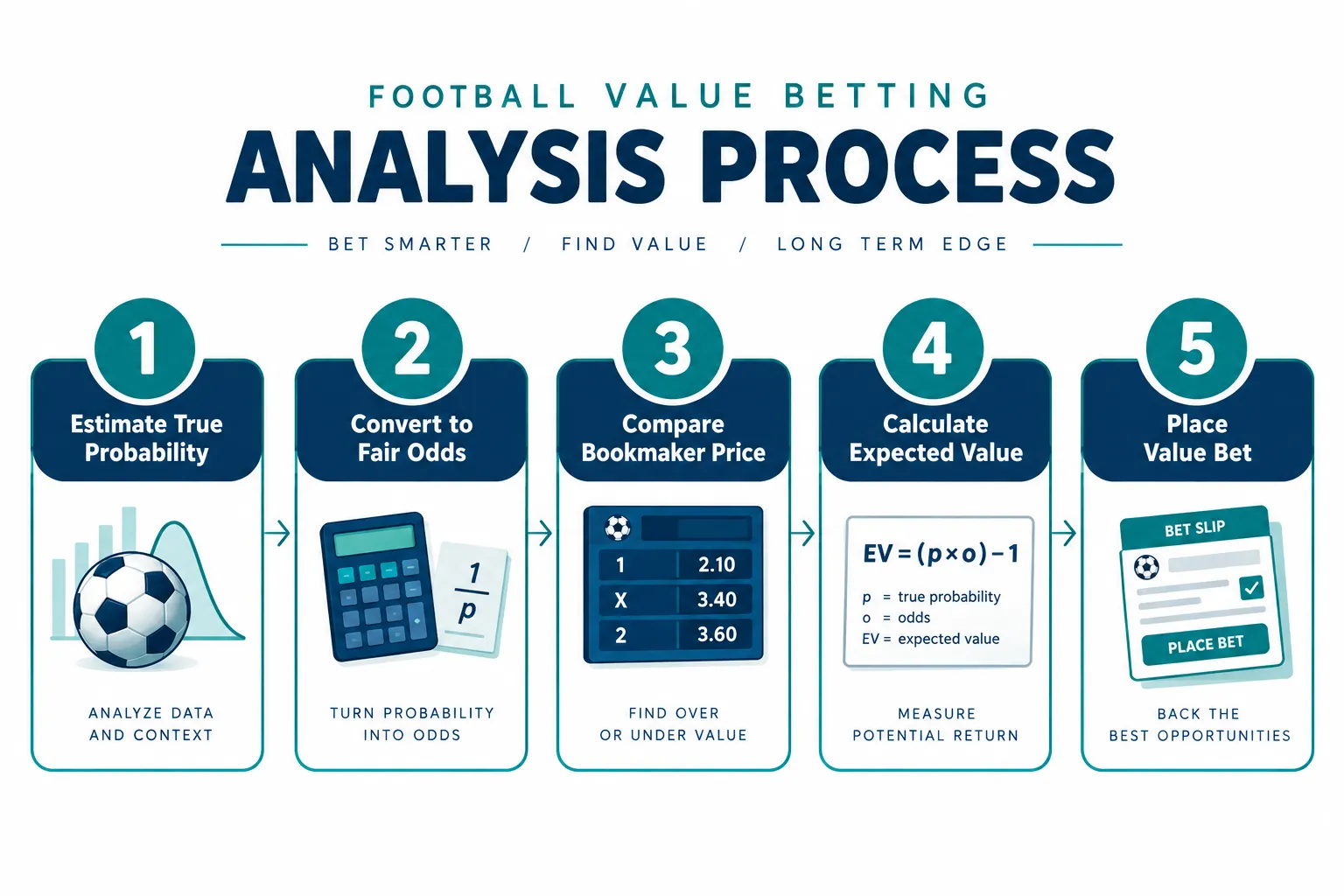
Finding undervalued odds requires a systematic process. The following workflow reflects current best practice in football betting analysis for 2026.
Step 1: Build or access a probability model Use Expected Goals (xG) data to estimate each team’s attacking and defensive strength. xG measures the quality of chances created and conceded, not just goals scored, making it a more stable predictor of future performance than raw results. [8]
Step 2: Apply a Poisson distribution Feed team xG averages into a Poisson or double-Poisson model to generate match score probabilities. From those, calculate the probability of a home win, draw, or away win. [5] This is the foundation of the EGFO (Expected Goals and Fair Odds) workflow used by professional analysts. [1]
Step 3: Convert probabilities to fair odds Fair odds = 1 / Probability. If your model gives Team A a 45% win probability, fair odds are 1 / 0.45 = 2.22.
Step 4: Compare against bookmaker prices If the bookmaker is offering 2.60 on Team A, the implied probability is 38.5%. Your model says 45%. That gap is potential value.
Step 5: Apply a minimum edge threshold Only bet when your edge exceeds the bookmaker’s margin plus a buffer (typically 3-5% net edge). This filters out marginal cases where model error could wipe the advantage.
Best Tools and Software for Finding Value Bets
Several platforms and data sources make the value-finding process faster and more accurate in 2026.
- Odds-comparison sites: Compare prices across bookmakers in real time. A line that is out of step with the market consensus is a signal worth investigating.
- EV-finder platforms: Tools such as those referenced at xgaura.com scan multiple markets and flag bets where the implied probability is lower than a reference model’s estimate. [10]
- Poisson calculators: Dedicated tools convert xG inputs into match outcome probabilities automatically. [5]
- xG data providers: Detailed shot-level data from providers like those referenced at agentbets.ai and footyforecast.co.uk allow bettors to build or refine their own models. [8] [3]
- Daily value pick services: PremierBettingTips.com applies football betting analysis to surface value bets today across Premier League, Championship, and European markets, translating model outputs into actionable tips.
Choose a tool based on your skill level: Beginners benefit most from a curated value betting tips service while learning the underlying methodology. Experienced bettors can layer in raw xG feeds and build custom models.
Value Betting Strategy for Beginners
A beginner’s value betting strategy does not require advanced coding or a statistics degree. The core principles are straightforward and can be applied immediately.
Start here:
- Understand implied probability. Convert any decimal odds to a probability: Implied Probability = 1 / Decimal Odds. A price of 2.50 implies a 40% chance.
- Find a reference model. Use a reputable football prediction tool or a service like PremierBettingTips football analysis to get independent probability estimates.
- Compare systematically. Build a simple spreadsheet: list the match, your estimated probability, the bookmaker’s implied probability, and the calculated edge.
- Set a minimum edge rule. Only bet when the edge is at least 4-5% above the bookmaker’s implied probability. This accounts for model uncertainty.
- Use flat staking initially. Bet the same amount per selection until you have at least 200-300 bets to evaluate your true edge. [2]
- Track everything. Record every bet, the odds taken, the estimated probability, and the result.
Edge case: Positive expected value betting works over large samples. A run of 20 losing bets does not mean the strategy is broken. Variance is normal; the sample size needed to confirm an edge in football is typically 300-500 bets minimum.
How Much Juice or Vig Do Bookmakers Take
Bookmakers build a margin into every market by setting odds that sum to more than 100% probability. This overround is the “vig” or “juice,” and it is the structural reason why betting without an edge is a losing proposition.
Example: In a two-outcome market, a fair coin-flip would be priced at 2.00 / 2.00. A bookmaker might price it at 1.90 / 1.90. The implied probabilities are 52.6% + 52.6% = 105.2%. The extra 5.2% is the bookmaker’s margin.
In football three-way markets (home/draw/away), typical overrounds range from 5% to 8% at major bookmakers, and higher at smaller operators. [4] This means a bettor needs a consistent edge of at least 5-8% just to break even before profit.
Why this matters for value betting: Every value bet identified must clear the bookmaker’s margin before it generates profit. A 2% edge is not enough. A 7% edge on a market with a 6% overround leaves only 1% net advantage, which is marginal.
Can You Actually Make Money from Value Betting Long Term
Yes, value betting can be profitable long term, but only if the probability estimates are consistently more accurate than the bookmaker’s pricing. This is a high bar, and most casual bettors do not clear it.
What the evidence shows: Academic research and practitioner data both confirm that models using xG and Poisson distributions improve match outcome prediction accuracy compared to raw results-based approaches. [3] [8] Better probability estimates mean more genuine edges are identified.
Realistic expectations:
- Professional value bettors typically target returns of 3-8% on turnover over a full season.
- Bookmakers limit or close accounts of consistently winning bettors, which is a practical constraint on long-term profitability at traditional sportsbooks.
- Betting exchanges (where you bet against other bettors, not a bookmaker) do not limit winners, making them better venues for long-term value betting.
Who it is not for: Bettors seeking guaranteed short-term profit, or those unwilling to maintain detailed records and tolerate losing streaks of 10-20 bets.
How Sharp Bettors Find Value That Casual Bettors Miss

Sharp bettors, also called professionals or wiseguys, find value through superior information processing, not insider knowledge. The gap between sharp and casual bettors comes down to three areas.
1. Better probability models Sharps use shot-level xG data, team form adjusted for opponent quality, injury and lineup data, and sometimes weather and travel factors. Casual bettors rely on league tables and recent results, which are noisier signals. [9]
2. Market timing Bookmakers open lines early, when uncertainty is highest. Sharps bet early on markets where they have a model edge, before the line moves toward fair value. By the time a casual bettor places a bet, the line has often already corrected.
3. Market selection Sharps focus on markets where bookmaker pricing is weakest: lower-division matches with less public attention, Asian handicap lines, and player-specific props. Premier League match result markets are heavily efficient because bookmakers dedicate significant resources to pricing them accurately. [6]
PremierBettingTips value betting applies sharp-style football betting analysis to identify markets where the public and bookmaker consensus diverges from model-derived probabilities, surfacing value bets today that casual bettors overlook.
Value Betting vs Arbitrage Betting: Which Is Better
Value betting and arbitrage betting are both systematic approaches, but they differ in risk profile, scalability, and account longevity.
Arbitrage betting involves backing all outcomes of an event across different bookmakers to guarantee a profit regardless of the result. The profit margin is small (typically 1-3%) but risk-free.
Value betting involves backing outcomes where the odds are higher than fair value. Each individual bet carries risk, but the edge compounds over a large sample.
| Factor | Value Betting | Arbitrage Betting |
|---|---|---|
| Risk per bet | Yes (variance) | None (guaranteed) |
| Account lifespan | Moderate | Very short (bookmakers detect and limit quickly) |
| Profit potential | Higher (3-8% ROI) | Lower (1-3% ROI) |
| Complexity | Moderate | High (multiple accounts needed) |
| Scalability | Good | Poor (limited by account restrictions) |
Choose value betting if you have a reliable probability model, can tolerate variance, and want a sustainable long-term approach. Choose arbitrage if you want guaranteed returns on a short-term basis and are prepared to manage many bookmaker accounts. [7]
How to Track Your Bets and Measure If You Are Finding Real Value
Tracking bets is not optional for serious value bettors. Without records, there is no way to distinguish a genuine edge from luck.
What to record for every bet:
- Match and market
- Bookmaker odds taken
- Your estimated probability at the time of the bet
- Stake
- Result (win/loss)
- Calculated EV at time of bet
Key metrics to monitor:
- Return on investment (ROI): Total profit divided by total staked. A positive ROI over 300+ bets is a meaningful signal.
- Closing line value (CLV): Compare the odds you took to the odds available just before kick-off. If you consistently beat the closing line, your model is identifying real value before the market corrects. CLV is considered the most reliable real-time indicator of a genuine edge. [2]
- Actual vs expected results: If your model assigns 40% probability to selections that win 40% of the time over a large sample, the model is calibrated correctly.
Minimum sample size: Do not draw conclusions from fewer than 200 bets. Football has high variance, and short samples are dominated by luck.
What Sports Markets Have the Most Value Opportunities
Football offers the widest range of value betting opportunities of any sport, but not all markets are equally inefficient.
Markets with more value:
- Lower-division leagues (Championship, League One, Bundesliga 2, Serie B) where bookmaker pricing is less precise
- Asian handicap and over/under goals markets, which are harder to price accurately
- Early-season matches where team strength is harder to assess
- Matches with significant team news (injuries, suspensions) that bookmakers are slow to price in
Markets with less value:
- Premier League, Champions League, and La Liga match results, which are heavily traded and efficiently priced
- Outright winner markets, which are dominated by bookmaker margin
PremierBettingTips football analysis covers both top-tier and lower-division markets, applying consistent xG-based methodology to find value bets today wherever the pricing inefficiency is greatest. [6]
Is PremierBettingTips Worth Subscribing to for Value Picks
PremierBettingTips.com applies systematic football betting analysis to identify positive expected value betting opportunities across multiple markets. For bettors who lack the time or technical background to build their own xG models, a curated value betting tips service provides a practical shortcut to applying the same principles that sharp bettors use.
What to look for in any value betting tips service:
- Transparent track record with verified results over a minimum of one full season
- Clear explanation of the methodology behind each pick
- Odds recorded at the time of publication (not after line movement)
- Consistent focus on EV, not just win rate
A high win rate with poor odds selection can still be a losing strategy. A lower win rate with genuine value on each selection is profitable. PremierBettingTips value betting tips are built around the EV framework, not simply picking winners.
Common Mistakes People Make When Looking for Value Bets
Even bettors who understand value betting theory make predictable errors that erode their edge.
- Overestimating model accuracy: No model is perfectly calibrated. Applying a 5% edge threshold helps absorb model error.
- Ignoring the bookmaker’s margin: Comparing raw probabilities without stripping out the overround leads to false positives.
- Betting too many markets: Spreading across dozens of markets dilutes focus. Depth of analysis in a few markets beats shallow coverage of many.
- Chasing losses: Increasing stake size after a losing run violates the statistical logic of value betting. Flat staking or Kelly-based staking is more disciplined.
- Using too small a sample: Declaring a strategy “working” or “broken” after 50 bets is statistically meaningless.
- Neglecting line movement: If odds shorten sharply after you identify a bet, the market may have already corrected the value. Always check closing line value. [2]
Conclusion
Value betting in football is not about picking winners more often than chance. It is about finding odds that are mispriced relative to the true probability of an outcome, then exploiting that gap systematically over a large sample of bets.
Actionable next steps:
- Learn to convert decimal odds to implied probability and back again. This is the foundation of every value calculation.
- Access xG data for the leagues you follow and compare team attacking and defensive ratings. Even a basic understanding of xG improves probability estimates significantly.
- Set up a tracking spreadsheet today. Record every bet with the odds taken, your estimated probability, and the result.
- Use PremierBettingTips.com value betting tips and football betting analysis as a reference point while developing your own methodology. Compare the service’s probability estimates to your own to identify where your model diverges.
- Focus on closing line value as your primary performance metric. Consistently beating the closing line over 300+ bets confirms a genuine edge.
- Be patient. Value betting rewards discipline and sample size, not short-term results.
The edge is real, but it requires rigorous process, honest tracking, and the willingness to accept variance as part of the strategy.
FAQ
What is the simplest definition of a value bet? A value bet is a wager where the bookmaker’s odds are higher than the true probability of the outcome warrants. If you estimate a 50% chance of an event and the bookmaker offers odds implying 40%, that is a value bet.
Do I need to be good at maths to find value bets? Basic arithmetic is enough to start. Converting odds to probability (1 / decimal odds) and calculating EV are the core skills. Tools and services handle the complex modelling.
How many bets do I need before I can tell if my strategy is working? A minimum of 200-300 bets is needed to draw any meaningful conclusion. Football variance is high, and smaller samples are dominated by luck.
What is closing line value and why does it matter? Closing line value (CLV) measures whether the odds you took were better than the odds available just before the event started. Consistently beating the closing line is the strongest real-time indicator of a genuine edge.
Is value betting legal? Yes. Value betting is legal in all jurisdictions where sports betting is permitted. Bookmakers may restrict accounts of consistent winners, but the activity itself is not illegal.
What is the bookmaker’s overround? The overround is the margin built into bookmaker odds. In a three-way football market, the implied probabilities of all outcomes sum to more than 100%. The excess above 100% is the bookmaker’s built-in profit margin.
Can I use value betting on in-play football markets? Yes, but in-play markets move very quickly and require faster decision-making. Pre-match value betting is more accessible for most bettors.
What is xG and why is it used for value betting? Expected Goals (xG) measures the quality of chances created and conceded based on shot location, type, and context. It is a more stable predictor of future performance than raw goals scored, making it the preferred input for football probability models.
What is a Poisson model in football betting? A Poisson model uses each team’s expected goals per game to calculate the probability of every possible scoreline, and from those, the probability of a home win, draw, or away win. It is the standard mathematical framework for football match prediction.
How does PremierBettingTips football analysis identify value bets? PremierBettingTips applies xG-based probability models and odds comparison to identify markets where bookmaker pricing diverges from model-estimated fair odds, then publishes those selections as value betting tips with the supporting analysis.
What is the difference between ROI and win rate? Win rate is the percentage of bets that result in a win. ROI is total profit divided by total staked. A bettor with a 40% win rate at average odds of 3.00 has a higher ROI than one with a 60% win rate at average odds of 1.50.
Are lower-league football markets more profitable for value betting? Generally yes. Bookmakers allocate fewer resources to pricing lower-division matches, creating more frequent mispricings. However, data quality for lower leagues is also lower, so model accuracy may be reduced.
References
[1] Egfo – https://www.betcheck.ai/egfo.html [2] Chapter 19 – https://datafield.dev/sports-betting-textbook/part-04/chapter-19/ [3] Football Prediction Statistical Modelling – https://footyforecast.co.uk/football-prediction-statistical-modelling/ [4] Football Value Bets – https://footballbetodds.com/guides/football-value-bets/ [5] Poisson Calculator – https://www.bettoredge.com/poisson-calculator [6] Best Value Predictions 2026 08 14 – https://football-predictions.ai/articles/best-value-predictions-2026-08-14 [7] Value Bets World Cup – https://wcnzsoccer2026.com/value-bets-world-cup/ [8] Expected Goals Xg Betting Model – https://agentbets.ai/guides/expected-goals-xg-betting-model/ [9] Expected Goals Explained And How To Use It To Win Bets – https://www.planetsport.com/soccer/betting-guides/expected-goals-explained-and-how-to-use-it-to-win-bets [10] Value Bets – https://www.xgaura.com/value-bets